 Cottage at Home
Disclosure: some links below are affiliate links, and if you buy through one we may earn a small commission, at no extra cost to you.
Cottage front door ideas: colours, brass and keeping the door you have
A cottage front door, kept and dressed: the colour and how to choose it from the road, the knob and old brass, the step, a wreath all year, and the inside face.
In this guide
Nobody looks at their own front door. You come home with your hands full, you put the key in, and the door you see is the one in your head from the day you moved in. Everyone else sees it first. This page is about the door you already have: what makes it look like a cottage door, the colour, the brass, the step, a wreath through the year, and the inside face, which you look at every day.
Most of what comes up when you search for a cottage front door is someone selling you a new one. Some houses need that, and there is a section near the end for them. But a sound old door with a good coat of paint does more for a cottage than almost anything you could buy.
What makes a front door look like a cottage door
A cottage front door is a painted wooden door with panels, often a little glass near the top, and brass that has been handled for years. What makes it read as cottage is mostly proportion and wear: plain panels rather than carving, a colour with some grey in it, and hardware that has gone soft at the edges.
The panels matter more than people expect. Four or six plain raised panels, or upright boards on a simple ledged door, give the door its shadow lines, and those lines are what you see from the road. A door that is flat, or one covered in mouldings and arches, loses that quiet look even in the right colour.
Glass belongs high, if anywhere. A small pane or a row of them in the top rail lets the afternoon into the hall without putting the whole room on show, and you can see one in the picture of the inside of a door further down. A big pane at eye level turns the door into a window, which is a different thing.
Is the old door worth keeping?
Usually, yes. A solid wooden door that sticks in August, rattles in a wind or lets a line of daylight round its edge is a door that needs easing, weatherstripping and paint, not a new door. It was made to fit that opening, and it carries the proportions the rest of the front was built around.
Tap it and look at the bottom edge, where rain and snowmelt sit longest. If the wood there is firm, the door is worth keeping. A carpenter can plane a door that binds, refit a sagging one on its hinges, and fit a draught strip round the frame in an afternoon. That costs a fraction of a new door and the paint goes over the lot.
The honest case for replacing is rot that has gone right through, a door that will no longer close and lock properly, or one that was a poor replacement in the first place. Those are real, and there is a section for them below.
What colour should a cottage front door be?
Choose it from the road, in daylight, with the whole house in view. The right colour belongs with the siding, the trim and the roof together, not with a paint card held up in a shop. Muted greens, deep blue-greys and near-blacks suit most cottages, and a bright, clean colour almost always reads as new.
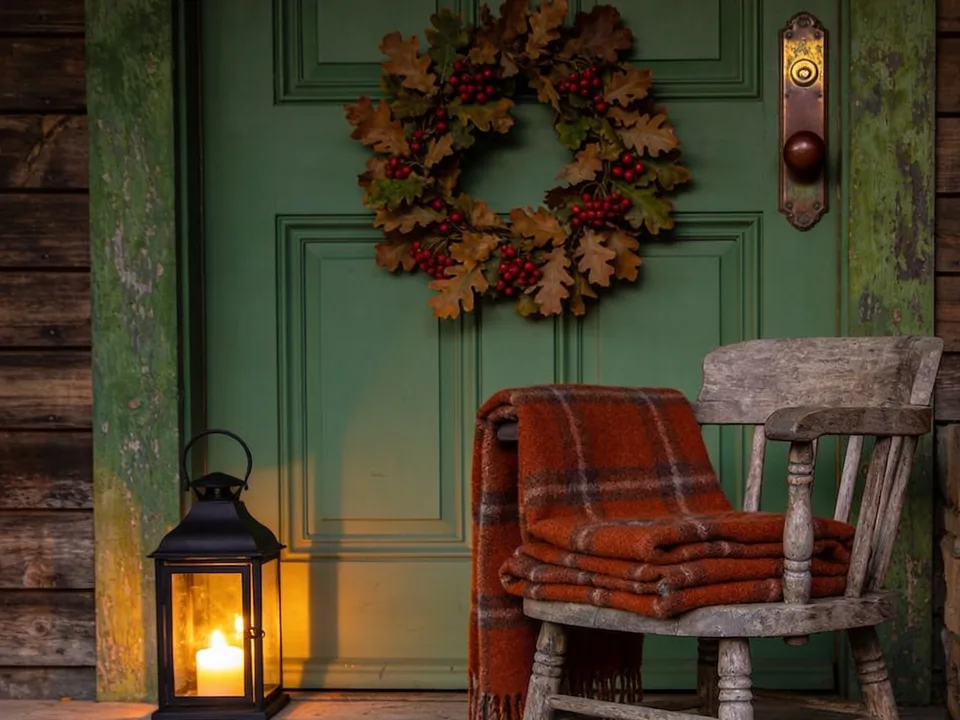
Stand on the far side of the road at midday and look at what the door has to sit with. Dark weathered boards, like the ones in the picture at the top, take a softer green or a pale stone colour well, because the door then reads as the lightest thing in the wall. White or cream siding can carry something much deeper: a bottle green, a navy with grey in it, a black that is not quite black.
Then test it on the door, not on a chip. Paint a large piece of card, tape it over a panel, and leave it there for a few days. Look at it in morning light, at dusk, and on a grey afternoon. A green that looks muddy on the card in the shop can be exactly right on the door, and the other way round.
For the finish, most paint makers point to semi-gloss for an outside door, because it stands up to weather and wipes clean. On an old door with dents and filled cracks, satin is kinder: the shinier the coat, the more it shows every flaw. Flat paint is the one to avoid outside.
The frame and the step can stay plainer. A frame painted the same colour as the door makes the door look bigger. A frame in the trim colour of the house makes the door look set into the wall. Either is fine; just don't give the frame a third colour of its own.
Knob or lever, and what to do with the old brass
A round knob on a long backplate is the cottage answer, and old brass is worth keeping as it is. If the door still carries its original knob, plate or knocker, clean it and put it back. Worn brass that has gone dark at the edges and pale where hands touch it is the detail a new door cannot fake.
A lever is easier to open with full hands, and if anyone in the house finds a knob hard to turn, choose a lever without a second thought. The look of a lever comes close if it is plain, in brass or black iron, and sits on a backplate rather than a small round rose.
Whether to polish is a matter of taste. A brass knob polished bright every week looks smart and a little formal. One left alone goes a soft brown with a bright spot where the hand goes, and on a cottage door that is usually the better look. What it should never be is painted over, which is how old brass gets lost on a lot of doors.
Knocker, bell, number and letter plate
Pick the few you actually use and leave off the rest. A cottage door looks best with two or three pieces of hardware, not six. The knob, a number someone can read from the road, and then one of a knocker or a bell is usually enough. Everything should be brass or black iron, and all of it the same.
A vintage brass door knocker goes on the centre line of the door at about chest height, on the top rail or the rail just above the middle. If you have a working doorbell as well, the knocker becomes the decoration and the bell does the work, and that is fine.
The number matters more than it looks. Put it where a delivery driver can read it from the road at dusk, on the door or on the frame beside it, in plain numerals large enough to see from a car. If the post still comes through your door, an old brass mail slot set in the lowest rail looks right and matches the rest. If it goes to a box at the road or down the street, leave the door without one.
What stands on the step beside it
One light, one thing to sit on or set things down on, and room to open the door. The step in the picture at the top has exactly that: a lantern on one side and an old wooden chair on the other. Anything more and the front door starts to look like a shop window.
A lantern by the door earns its place on the dark afternoons from November on. A candle in a metal lantern is lovely in a sheltered spot, and a battery candle in the same lantern is safer anywhere wind or a child might knock it. The lighting page has more on light at the door.
A chair by the front door is not really for sitting. It is where the shopping goes while you find the key, where a parcel waits, where a blanket lives in October. A small bench does the same job if the step is wide enough. If the step is narrow, leave it out; a clear path to the door matters more.
A boot scraper set into the step, or standing beside it, is the one other thing worth having on a cottage that sees mud or snow. The cottage fall porch dresses the same step for autumn, with the pumpkins and the plaid, and the season's wreath.
A wreath through the year, not just in October
A wreath on a cottage door works in every season if it is made of what is growing then. Evergreen and cedar from late November to the end of winter, bare twigs or pussy willow in early spring, dried lavender or hydrangea heads through the summer, and leaves and berries in the fall.
The hanger makes more difference than the wreath. Hang it from a plain over-the-door hook or a ribbon run over the top of the door and tacked on the inside, so it sits on the top panel or rail and clears the knocker. A wreath hung so low it covers the knob, or so high it touches the frame, always looks wrong.
The winter one is the one to get right. Cut cedar or spruce lasts weeks outside in the cold and smells of it every time the door opens, and Canadian Christmas decorations were built from the same hedge for that reason. Take it down when it browns, in January or February, and leave the door bare for a few weeks before the spring one goes up. A door with nothing on it now and then is part of the year too.
The inside of the front door
The inside face is the side you see most, so give it the same care. Paint it, keep its old lock and glass if it has them, and let it be a little darker or plainer than the hall around it. A front door seen from inside should look solid and quiet, the thing the house closes behind it.
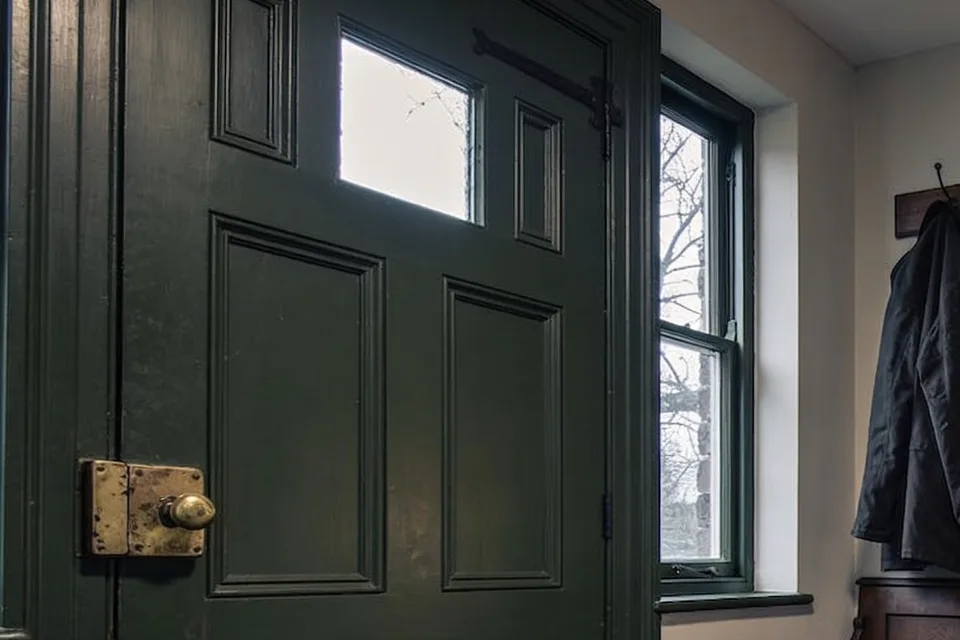
The door in that picture is painted the same deep green inside as the woodwork round it, which is one good answer. Another is the outside colour carried straight through, so the door is one colour on both faces. What tends to look wrong is a bright outside colour with a white inside face, because the edge of the door shows both when it opens.
The brass box on the left is a rim lock. It is a lock in its own case, screwed to the inside face of the door rather than cut into it, and it is the oldest kind of door lock in Britain and Ireland. Because the whole mechanism sits in its case, old ones could be unscrewed and taken along when a family moved house. If your door has one, keep it and clean it. If it doesn't, an antique brass rim lock can go on as a latch beside a modern lock, as long as the modern lock still does the locking.
The small pane at the top is worth keeping clear. No film, no curtain, nothing stuck on it. The light it lets in falls straight down the hall in the afternoon. The cottage entryway goes through what happens on this side of the door in winter: the hooks, the settle, the tray for wet boots.
If you do replace it, what to carry over
Copy the old door, not a catalogue. Measure its panels, note where the glass was, and ask for a new door with the same layout, painted rather than stained or wood-grained. Then move the old brass across: the knob and plate, the knocker, the number. The house will hardly notice the change.
Composite and steel doors are sold in cottage styles, and some are well made. The ones that pass best on an old house are the plainest: square panels, a small light at the top or none, and a smooth face you can paint in your own colour later rather than a moulded wood grain. Keep the frame if it is sound, so the opening stays the shape it always was.
Start with the paint
If you only do one thing this year, paint the door. Take the hardware off, fill and sand the worst of it, two coats in the colour you chose from the road, and put the old brass back on. It is a weekend's work, and it changes how the whole house looks.
Common questions
What colour should a cottage front door be?
A colour that belongs to the house rather than one chosen from a card. Stand at the road in daylight, look at the siding, the trim and the roof, and pick a colour that sits with all three. Muted greens, deep blue-greys and near-blacks suit most cottages; a bright, clean colour usually reads as new.
Should you replace an old cottage front door?
Keep it if the wood is sound. A solid panelled door that sticks, rattles or lets in a draught can usually be eased, weatherstripped and painted for far less than a new one, and it keeps the proportions the house was built around. Replace it when the wood itself has rotted through or the door no longer closes and locks properly.
What paint finish is best for a front door?
Most paint makers point to semi-gloss for an outside door, because it stands up to weather and wipes clean. On an old wooden door with dents and filled cracks, satin is kinder, because a shinier coat shows every flaw. Flat paint is the one to avoid outside.
What is a rim lock?
A rim lock is a lock in its own box, screwed to the inside face of the door rather than cut into it. It is the oldest kind of door lock in Britain and Ireland, and because the whole mechanism sits in its case, old ones could be unscrewed and taken along when a family moved house.