 Cottage at Home
Disclosure: some links below are affiliate links, and if you buy through one we may earn a small commission, at no extra cost to you.
Cottage fireplace ideas: the surround, the hearth and the fire itself
What makes a fireplace look cottage, from the surround and hearth to the log basket, the screen and the chairs. And the woodstove at the lake.
In this guide
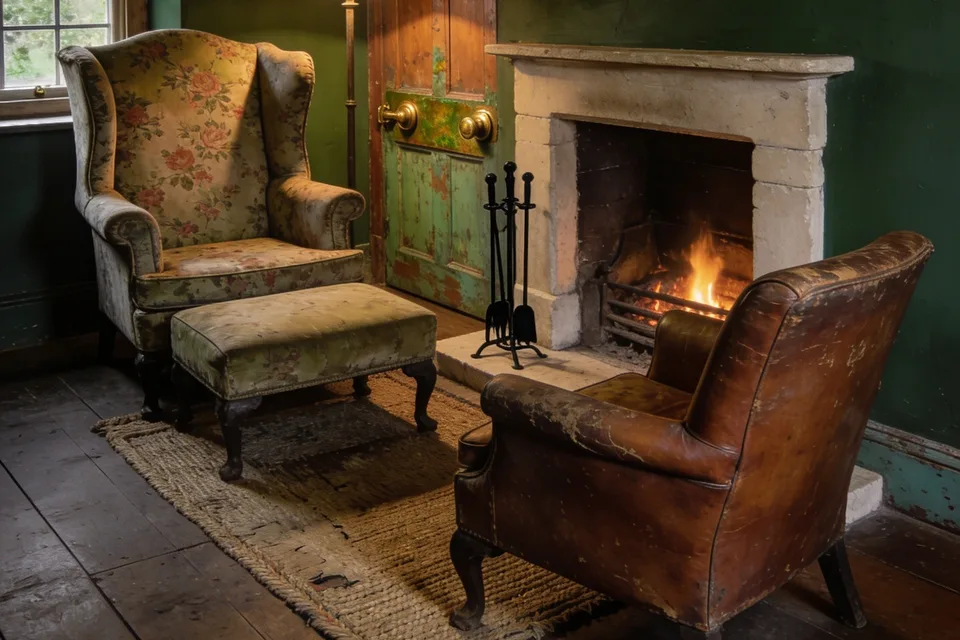
A cottage fireplace is a plain one that gets used. One material for the surround, a low wide opening, a hearth you could put a cup on, and around it the signs of fires actually lit: a basket of wood, a stand of tools, a chair turned in. This is about each of those parts, from the stone to the chairs. The shelf on top has its own page.
What makes a fireplace look cottage
A fireplace looks cottage when it is plain, low and plainly used. The surround is one material, brick or stone or painted wood, with no tile border or veneer. The opening is wider than it is tall, the hearth sits at the height of your ankle, and there is wood beside it, not a vase where the wood should be.
Most fireplaces in the pictures people save were bought as a feature: a grand stone wall to the ceiling, a slab of marble, a firebox lit from inside with no ash in it. A cottage fireplace was built to heat the room and has been doing it for a long time. That is what you are matching. The quickest test is to ask whether a fire could be lit in it tonight without moving anything. If the answer is yes, most of the look is already there.
Brick, stone, plaster or painted wood
Keep old brick and stone exactly as they are; a hundred winters of soot and wear is the one finish nobody can buy. Paint only brick that was never handsome, in a soft flat white. Plaster or limewash with a plain wooden shelf is the quietest surround of all. Whatever it is, use one material, not two.
Each one suits a different room. Brick is warm and slightly rough, and it looks right in a kitchen or a low sitting room. Pale stone, like the one in the picture above and in the English cottage living room, holds the light from the fire and the lamps and keeps a dark room from going black. Painted wood, a simple pine surround with a bracket under the shelf, is the cottage version you find at the lake and in small farmhouses, and it takes a colour well: deep green, cream, an old red.
The thing to avoid is the makeover that adds a second material. Tile laid over brick, a stone veneer over plaster, a white frame put around something that was fine. If the surround is ugly, paint it or plaster it, keep the paint to the face of it, and leave the inside of the firebox bare and black.
The hearth floor
The hearth is the stone or brick floor in front of the fire, and in a cottage it is used. Keep it pale and clear and let three things live there: a small lamp, the log basket at one end, and a stand of tools at the other. When the fire is lit, nothing that burns sits on it.
A raised hearth is the best seat in the house on a cold evening, and it is where the cup of tea goes, the boots go to dry, and the dog goes. That is why it should be stone, brick or tile and nothing else: it is there to catch the spark that jumps and the ember that rolls. A rug in front of it is lovely, as long as it starts where the hearth ends and is not slid up onto it.
The low lamp matters more than it sounds. Cottage lighting puts the room's light below eye level, and a small lamp on the hearth or the floor beside it is how the fireplace stays the warm point of the room on the nights it isn't lit.
What goes in the firebox
Inside, a cottage firebox is black, swept and ready. In winter it holds a fire, or a fire laid and waiting to be lit. In summer it holds something living, a jug of green branches or a few birch logs stood on end, so the room is not facing a cold black hole for four months.
A laid fire is one of the best things you can do for a room, lit or not. The cozy fall living room goes through how to lay one; the short version is crossed kindling over a firelighter and three split logs. Keep the grate itself plain. A black iron basket grate is the classic, and it is worth finding an old one if yours is bent or burnt through.
What doesn't belong in there all year is the row of white pillar candles. It's a nice picture, but it says the fire is never lit. Save the candles for a fireplace that genuinely doesn't work, and see the end of this page for that one.
The log basket, and where the wood lives
Wood gets carried twice: once from the pile to a basket by the back door, and once from there to the basket by the fire. Only that last basket is seen. Keep about a day's worth in it, and keep the rest outside, stacked off the ground with only the top covered so the wind can dry it.
The basket is the thing worth looking for second-hand. A deep round one of wicker or willow, gone soft and grey with use, or an old copper coal scuttle, or a wicker log basket with a hessian lining so the bark stays in it. Put it at one end of the hearth, never directly in front of the fire, and a small box of kindling beside it.
The wood itself should be dry. Split it, stack it, and leave it at least six months, longer for hardwood, until it reads below 20 percent moisture on a cheap meter. Wet wood smokes, hisses, blackens the glass and the chimney, and gives very little heat.
The screen, the tools and the fender
Three things go on the hearth to make it work: a screen, one stand of tools, and, in an older room, a low fender along the front. Choose a plain screen you will actually move, because the rule is simple: when you leave the room, the screen goes across. Tools should be black iron, plain, and used.
A matching brass set bought all at once looks like it was bought all at once. A plain black iron stand from one place and an old fender from another look like a house that has had a fire for years. A vintage fire screen is easy to find second-hand, from fine black mesh in a simple frame to a sturdy iron fireguard; pick one tall enough to cover the whole opening.
The dark cottage living room lets an old brass fender be the brightest thing in the room once the fire is down to embers, and that is the one place shine earns its keep at the fireplace.
The woodstove at the lake
At the lake the hearth is usually a woodstove: black cast iron, a glass door, a stone or brick pad under it, and a kettle on top. It changes one thing. A fireplace sits flat against a wall, so the room faces the wall; a stove often stands in a corner, so the chairs turn to the corner instead.
Everything else carries over. The pad under the stove does the hearth's job and gets the same rule: nothing that burns on it while the stove is going. The woodbox stands beside it, the tools hang on the wall, and the kettle on top earns its place on cold mornings. A vintage enamel kettle in cream or red is the one bright thing a black stove can carry.
The stove also sets the calendar. The Muskoka room is closed up at Thanksgiving, and at a cottage that stays open into the cold months, the evenings move inside to the stove from then on. Where a stove sits and what goes around it is a job for a certified installer, not a decorating choice. In Canada that usually means someone certified under WETT, and your insurer will often ask for their inspection report.
The chairs, and the television
Two chairs angled in toward the fire, close enough to feel it, with a small table and a lamp between them. That is the arrangement. The sofa can sit further back facing the fireplace, but the two chairs nearest the hearth are the ones that get used. The television goes on a side wall, low, never above the mantel.
The chairs needn't match. A wing chair in faded floral and a worn leather one, as in the picture, have more to say to each other than a pair. A footstool between them, a throw over one arm, and the lamp on the far side from the fire, so the reader has light on the page and the fire on their face.
A television over the fireplace is the most common fight in this room, and the room usually loses. Up there it sits far too high to watch comfortably from a chair, and it takes the one wall everything else faces. On a side wall, low, it can be watched when it's on and forgotten when it isn't, and the fire gets its wall back.
A fireplace that doesn't work
A fireplace that can't be lit is still the centre of the room, so keep it as one. Leave the surround, keep the hearth clear and lamplit, and put the chairs where they would be anyway. If you hope to light it again, have the chimney looked at first; judge an electric insert by how it looks switched off.
Before you light a fire in any fireplace that has stood unused, have the chimney inspected and swept. In the US the usual person is a chimney sweep certified by the Chimney Safety Institute of America, and their standard is a yearly inspection even for a chimney used lightly; in Canada, look for someone certified under WETT. Whatever you burn in, keep a working smoke alarm and a carbon monoxide alarm on the same floor, and when you clear out the ash, put it in a metal bucket with a lid and carry it outside.
An electric insert is a fair answer in a room with no working chimney. Most of the time it is off, so choose the plainest one you can find, with a black or dark surround and no lit-up logs, and the mantel above it does the rest.
Start with the chair
Tonight, turn the nearest chair so it faces the fireplace, and look at the hearth from it. Take off anything that isn't wood, tools or a lamp, move the log basket to one end, and lay a fire, even if you don't light it. Most of a cottage fireplace is decided from that chair, and it costs nothing to find out.
Common questions
What makes a fireplace cottage style?
One plain material for the surround, a low opening that is wider than it is tall, a hearth you could set a cup on, and signs that the fire really gets used: a basket of wood, a stand of tools, a little ash in the grate. Nothing about it was bought as a feature.
Should you paint a brick cottage fireplace?
Leave old brick that has a good colour as it is, because it already looks right and paint is hard to undo. Paint only brick that was never pretty, in a soft flat white or a warm off-white, on the face of the surround alone. The inside of the firebox stays bare and black.
Can you put a TV above a cottage fireplace?
It is better on a side wall. Above the mantel a television sits far too high for anyone watching from a chair, and it takes the one wall the whole room faces. Put it on a side wall, low, where it can be watched when it is on and ignored when it is not.